


Types of Bricks Used in Construction in India: Sizes, Quality & IS Codes
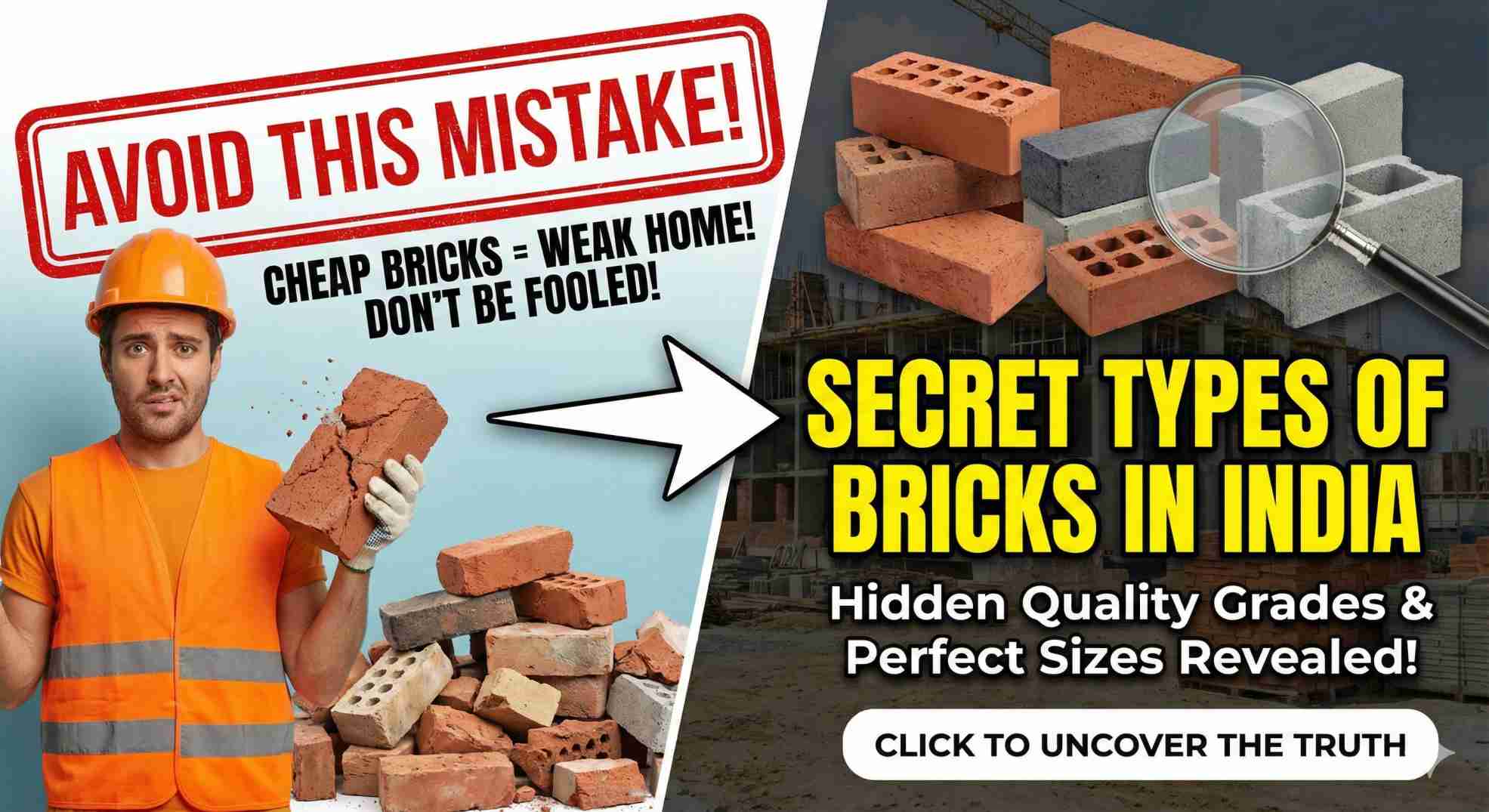
Bricks are one of the most important building materials used in construction across India. From village houses to multi-storey buildings, bricks provide strength, durability, and thermal comfort. Selecting the correct type and quality of brick is essential for ensuring the safety and long life of a structure.
In India, bricks are classified based on size, manufacturing method, material, and quality grade. This guide explains brick sizes, different types of bricks, quality grades such as 1st class, 2nd class, and 3rd class bricks, along with Indian Standard (IS) codes.
Standard Brick Size in India
As per Indian Standards, modular bricks are most commonly used in construction.
Standard brick size (without mortar):
190 mm × 90 mm × 90 mm
Nominal brick size (with mortar):
200 mm × 100 mm × 100 mm
These standard sizes help ensure uniform construction and accurate estimation of materials.
Types of Bricks Used in Construction
1. Burnt Clay Bricks
Burnt clay bricks are traditional bricks made from natural clay and fired in kilns. They are widely used for walls, foundations, and columns.
2. Fly Ash Bricks
Fly ash bricks are made using waste material from thermal power plants. They are eco-friendly, uniform, and absorb less water than clay bricks.
3. Concrete Bricks
Concrete bricks are made from cement, sand, and aggregates. They are commonly used for boundary walls and decorative masonry.
4. Engineering Bricks
Engineering bricks have high compressive strength and low water absorption. They are suitable for foundations and damp-proof courses.
5. Fire Bricks
Fire bricks are heat-resistant bricks used in furnaces, chimneys, and fireplaces.
Brick Quality Grades in India
First Class Bricks (1st Class)
- Uniform shape and size
- Sharp edges and smooth surface
- High compressive strength
- Water absorption less than 20%
- Used for load-bearing and permanent structures
Second Class Bricks (2nd Class)
- Slightly irregular shape
- Rough surface
- Moderate strength
- Used where plastering is done
Third Class Bricks (3rd Class)
- Poor finish and shape
- Low strength
- High water absorption
- Used for temporary structures only
Indian Standard (IS) Codes for Bricks
- IS 1077: Specifications for burnt clay building bricks
- IS 3495 (Part 1–4): Tests on burnt clay bricks (compressive strength, water absorption, efflorescence)
Brick Quality Comparison Table
| Brick Grade | Strength | Water Absorption | Recommended Use |
|---|---|---|---|
| First Class | High | Low | Permanent & load-bearing structures |
| Second Class | Medium | Medium | Plastered masonry work |
| Third Class | Low | High | Temporary construction |
Approximate Brick Rates in India (Per 1000 Bricks)
| Brick Type | Price Range (₹) |
|---|---|
| First Class Clay Bricks | ₹7,000 – ₹9,000 |
| Second Class Bricks | ₹5,500 – ₹7,000 |
| Fly Ash Bricks | ₹4,500 – ₹6,500 |
| Third Class Bricks | ₹3,500 – ₹4,500 |
How to Check Brick Quality on Site
- Two bricks struck together should produce a clear ringing sound
- Bricks should not break when dropped from waist height
- Color should be uniform without cracks
- Water absorption should be limited after soaking
Conclusion
Bricks are the foundation of strong construction in India. Understanding brick sizes, types, quality grades, IS codes, and pricing helps homeowners, contractors, and builders make better decisions.
Choosing the right brick not only improves structural strength but also reduces maintenance costs and ensures long-term durability of the building.


